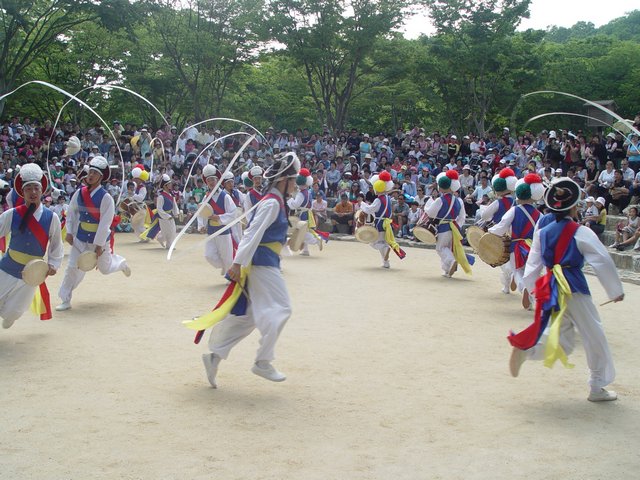
Farmers' Dance, Korean Folk Village
http://farm1.static.flickr.com/15/21117189_6d250d520b_o.jpg
June 17, 1988
Our next point of interest was the Korean Folk Village. We left Il San in the morning and drove about an hour or so outside of Seoul to this park. It opened in 1974 with the purpose to educate its visitors about Korean history and culture. It also serves as a venue to exhibit various forms of folk art. (I will compare it to Silver Dollar City sans the hillbilly touch.)
KFV is an impressive re-construction of Korea during the late Chosun period (1392-1894) when education emphasized loyalty, filial piety and Confucian ideology. You will see how the Koreans lived as their lifestyles are reproduced in the different exhibit houses. Performances by dancers and drummers might show a mask dance or paying homage for a bountiful crop. Other performances include ceremonies depicting events such as a wedding or even Shaman worship.
Throughout the park, you will find the houses of 30 folk villages that were relocated to create this outdoor museum. The villages typify the styles of housing found within the different regions of Korea. In addition, they reveal the inhabitants socio-economic status through their design and materials used to construct them.
We all seemed to enjoy the visit to KFV and it was a fun, multisensory and interactive way to learn about our heritage and its history. At that time, I'm sure that several of us had a limited background in Korean history, were clueless about the meaning of "filial piety" or had a comprehensive understanding of Confucianism and its infuence on Korean culture. Now, I'd like to return with my family and with a new appreciation. The visit to KFV had a long lasting effect as I still remember that day and it incited an interest in a culture that will never fade.


 Seoul Time


